IT automation benefits: A strategic guide for IT leaders
IT automation is shifting toward AI-driven, agentic systems that improve efficiency, agility and security while introducing governance and risk challenges for enterprises.

At legacy and cloud-first enterprise organizations, IT automation has steadily reduced the routine work involved in running and managing technology systems. Now, with AI-generated code and autonomous agents, that gradual evolution is turning into a high-stakes shift.
The rise of AI-assisted operations and intelligent orchestration expands the potential for autonomous IT powered by AI and agentic systems. It also amplifies the risks, especially around security, governance and quality control.
From early batch processing and scripting to modern automation and orchestration platforms, organizations have invested in IT automation to reduce routine manual operations and automate workflows. These approaches -- legacy scripts, scheduled jobs, orchestration tools and newer AI-assisted automation platforms -- often coexist within the same environment.
When IT automation is implemented effectively, core components such as infrastructure as code (IaC) and CI/CD pipelines can improve reliability and consistency while accelerating software delivery and system changes. They also reduce routine operational tasks, freeing up IT teams for higher-value work.
What IT automation means for modern IT organizations
IT automation refers to the use of software tools and, in some cases, orchestration frameworks to perform routine IT tasks, such as provisioning, configuration, monitoring and incident response, with minimal human intervention. These automated workflows are typically triggered by an event, schedule or condition and carry out actions such as system updates or patch management with little to no manual intervention.
Roughly 30% of enterprises will automate more than half of their network activities by 2026, compared with 10% in mid-2023, according to Gartner. More than half of enterprises will use AI-powered automation for Day 2 operations, including network monitoring, optimization and maintenance.
Although generative AI (GenAI)-assisted coding tools offer tangible benefits, adoption of system-level agentic AI remains in the early stages. Gartner expects that by 2028, roughly one-third of enterprise applications, including infrastructure and operations software, will incorporate agentic AI, up from 1% in 2024.
As more companies focus on expanding automation across network operations, incident management, provisioning and IT service management (ITSM), IT spending is increasingly being evaluated as a business investment, rather than solely as an operational cost. This shift is driven by the growing complexity of cloud and hybrid environments, the increasing expectations of always-on digital services and the need to operate at greater speed and scale without proportional increases in resources.
The core business benefits of IT automation
Moving beyond legacy approaches -- such as scripts, runbooks and siloed automation -- toward a broader strategy based on coordinated platforms and workflows can improve IT efficiency, streamline operations and help reduce and optimize infrastructure costs over time. An effective IT automation strategy can also enable organizations to increase business agility in response to rapidly changing market conditions.
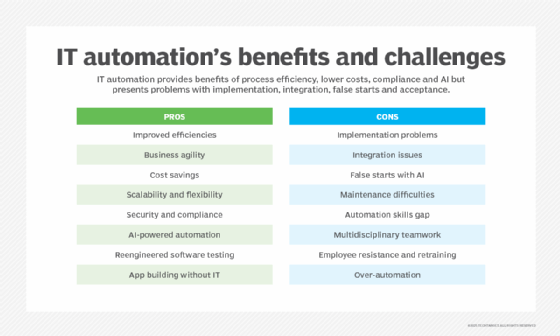
These improvements can benefit the business by enabling faster incident resolution, enhanced security and compliance, reduced operating costs and more efficient IT operations. However, these benefits typically depend on factors such as organizational maturity, implementation quality and governance.
Improved efficiencies
IT teams can use IaC to streamline technical and manual processes -- such as infrastructure management tasks associated with networks, servers and storage -- and improve cycle times (for example, from six hours to two hours), as well as throughput, error rates and task completion for better resource utilization.
AI for IT operations, also known as AIOps, is the next generation of technology. It collects data from IT infrastructure and uses AI, machine learning (ML) and natural language processing (NLP) to analyze data and help automate IT operations tasks.
IT service automation is often used to centralize patch management and service updates. Common use cases for IT service desk automation, which augments help desk ticketing systems, include password resets, user onboarding and data access management. The goal is to improve IT service response times -- so the machine processes more tickets in less time -- and error rates by reducing human intervention.
ITSM is moving from the first generation of chatbots, often built using robotic process automation (RPA), to AI agents. With the addition of GenAI, "the machine is able to make better connections and to resolve patterns at a much higher level, a more human level," said Craig Le Clair, vice president and principal analyst at Forrester Research.
Business agility
Using IT automation, real-time data and analytics can help companies proactively meet demands and quickly adapt to changing business requirements and market conditions. Businesses often need to pivot to extend their reach to new geographies or target different demographics. During the pandemic, many companies quickly deployed infrastructure and IT operations to accommodate workers anywhere, anytime, anyplace.
"You had to change how encryption works. You had to change how people were accessing very secure systems," said Frances Karamouzis, group chief of research and distinguished VP analyst at Gartner.
"People had to rethink very quickly: 'How do I stand up a new environment in a very different way to allow clients who are outside of the four walls of the organization physically to connect?' All of those things have a ripple effect throughout an organization," she added. "Your ability to have business agility at the highest level is the highest level of value."
Cost savings
Although businesses can expect to make significant investments in implementation and maintenance costs, IT automation can lower costs for infrastructure management, cloud services, application deployment, test environments and security incidents. In addition to improving efficiency, it can reduce labor costs.
Scalability and flexibility
A key feature of automation platforms is scalability and flexibility. As operating environments become more distributed and as data, applications and workloads increasingly move across public, private and hybrid clouds, IT automation systems should be able to meet changing demands and handle higher workloads and transaction volumes while minimizing performance degradation.
However, scaling often introduces latency or overhead, depending on the underlying infrastructure and architectural design.
Security and compliance
Cybersecurity is consistently a leading use case for automation, followed by infrastructure automation. Many organizations are taking a defensive posture in their use of automation, Le Clair noted, adding, "Let's first and foremost protect the company."
Automated frameworks and ML tools can automate workflows and repetitive tasks, such as domain blocking and compliance checks, used in systems management and network maintenance to help companies improve their security posture.
With AI-powered automation tools that use ML and data analytics, security operations center analysts can prioritize anomalies and focus on potential cyberthreats. AI-powered tools could address some challenges of security orchestration, automation and response platforms, which can be complex to implement and maintain.
For cloud security, IT operations can automate vulnerability scanning, misconfiguration identification, near-real-time alerts and, in some cases, incident response controls. Companies are also automating security functionality by building automation earlier into the development cycle, with security as part of the CI/CD pipeline (DevSecOps).
IT operations can perform better anomaly detection and remediation by using an AI agent to help resolve issues, Le Clair said. "Those who are coming in to attack those systems are going to be using those tools," he explained, "so you absolutely have to ramp up your investment of AI as a defensive measure."
AI-powered automation
As more industries adopt IT automation, platforms are emerging that can do more than automate repetitive rules-based tasks. These tools offer dynamic problem-solving, with some offering low-code or no-code self-service portals, and others functioning as service automation and orchestration platforms.
The ITBench framework, developed by researchers at IBM and the University of Illinois Urbana-Champaign and available on GitHub, evaluates AI agent personas across site reliability engineering, financial operations (cost efficiency and ROI) and compliance and security operations.
Legacy workflow automation tools face increasing competition from platforms with better integration, scalability and support for emerging technologies. Many technology companies are embedding AI, ML and NLP into enterprise automation platforms, including copilots that streamline automation development and help automate manual testing processes.
AI tools could help to democratize IT automation. Traditionally, midsize businesses struggled to get as much benefit from IT automation as large enterprises. "You needed a certain amount of critical mass, or scale, as well as investment or sunk costs," said Karamouzis. "With AI, especially agentic AI, it's become a more modular purchase -- plus the power of the tools -- so midsize enterprises can get a leapfrog effect."
Reengineered software testing
More companies automate testing and diagnostics of functionality across cloud and on-premises networks, databases, systems and applications. These testing setups are designed to automate QA testing in production environments to improve product quality, increase deployment speeds and ensure systems, data and workflow integrations perform correctly.
Automated software testing requires API testing tools and unit test frameworks that execute unit tests automatically when code changes. AI-powered tooling can automatically generate test cases, analyze code for defects and help perform test analysis.
More than half of IT and software engineering leaders surveyed by Gartner said API testing is the most common application of software automation, followed by integration testing and performance testing. Survey respondents cited higher test accuracy, agility and wider test coverage as among the top IT automation benefits, while a significant number (40%) revealed they automated testing continuously during their development cycles.
App building without IT
Low-code/no-code platforms and AI code assistants enable employees with fewer technical skills to develop web apps, mobile apps and workflows. Citizen developers outside of IT, according to Forrester's "Automation Predictions, 2025" report, will develop 30% of GenAI-powered automation apps using low-code tools. IT will need to assist with governance practices and establish data management guidelines to ensure security and compliance.
How IT leaders can successfully capture these benefits
According to analysts, the future of IT automation will involve agentic AI, which is designed to take actions and make decisions within defined boundaries. In enterprise environments, this typically includes guardrails and human-in-the-loop oversight.
Gartner estimated that 70% of enterprises will use agentic AI to operate their IT infrastructure by 2029. The shift, which aligns with CIO priorities, will allow leaders to automate complex workflows for more "proactive, predictive operations," wrote Paul Wang, Gartner senior principal analyst, in an analyst note.
As organizations work to implement AI and automation roadmaps, the first phase is to define strategy and prioritize high-impact use cases that are aligned with business outcomes. IT leaders should also establish the governance and operating models, including data governance, AI model risk management, and security and compliance controls. Success should be defined by using clear performance metrics and KPIs tied directly to strategic goals.
IT leaders can further prepare for agentic AI and automation by partnering with vendors to experiment, rather than waiting for operational data, noted Wang. They should also align workflows and talent with AI, starting with small projects that address specific problems to achieve early successes, or "wins," and then scale AI into core processes.
Quantifying the benefits of IT automation
Heads of IT operations -- especially in enterprise environments -- need to justify investments in IT automation initiatives and effectively communicate their business value to the CIO and other executives in terms of ROI, total cost of ownership, risk reduction, revenue growth and customer experience.
Cost optimization is measured with KPIs, such as operational cost savings (budget reduction) and cost avoidance (avoiding additional hires). Other metrics include cost per transaction (before and after automation); infrastructure utilization efficiency -- for example, improved autoscaling and scheduling in cloud-based deployments; and full-time equivalent capacity reallocation (estimated hours shifted to higher-value work).
Quality and consistency are evaluated using performance and reliability metrics, such as automated job success and failure rates and mean time to resolution. Additional indicators include error rate reduction (fewer errors than with manual processes), first-time-right rate (the percentage of tasks completed without rework) and reductions in incidents caused by human error or automation failures.
These performance and reliability metrics directly influence service availability, service-level agreement adherence and overall UX, linking automation performance to measurable business outcomes.
Finally, when it comes to autonomous IT, most organizations -- even those with advanced automation capabilities -- are still in the early stages. For many enterprises, automation tools such as RPA, AIOps and workflow orchestration are also beginning to blur the lines between IT automation and business process automation. However, governance, ownership and accountability models typically remain distinct across IT and business functions.
Kathleen Richards is a freelance journalist and industry veteran. She's a former features editor for TechTarget's Information Security magazine.
Dig Deeper on IT systems management and monitoring
-
![]()
6 best open source workflow engines for 2026
By: George Lawton
-
![]()
AI agents can speed up work without simplifying it
By: James Miller
-
![]()
IT orgs cautiously try AI agents for infrastructure as code
By: Beth Pariseau
-
![]()
Alteryx engineers contextualised business logic at the heart of agentic AI
By: Adrian Bridgwater