Artificial general intelligence: So close yet so far?
Before signing off on their AI strategies, businesses should weigh the anticipated arrival and potential impact of artificial general and super intelligence on future operations.
Despite its rapid development and widespread adoption, AI is a nascent technology with vast potential for enormous growth in the coming years.
Decades of science fiction make it easy to imagine a future in which AI evolves beyond task-focused point applications to offer broad, human-like intelligence. Although artificial general intelligence (AGI) is theoretical, the road to real AGI is fraught with serious technological and societal challenges. AGI developers face the daunting hurdles of making AGI work effectively, accurately, reliably -- and, most of all, safely.
What is artificial general intelligence?
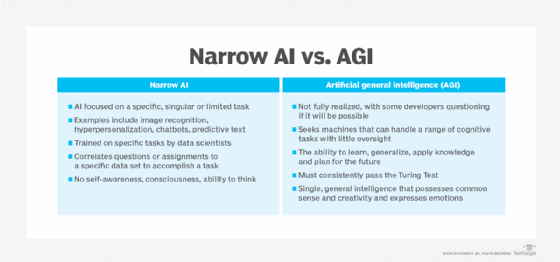
AGI is a generic label for any advanced AI platform that exhibits human levels of cognition and reasoning, learning and adaptation across several areas of expertise.
Unlike current task-specific AI systems, AGI can acquire knowledge across many domains. The system can use this generalized knowledge to potentially solve complex or unique problems without the need for retraining or reprogramming. The goal is to approach, meet and perhaps surpass human agility in problem solving. AGI exhibits three major characteristics:
Reasoning. An AGI system can reason, understand and formulate plans at human levels.
Generalization. AGI systems can use broad knowledge across different contexts and new situations.
Adaptability. AGI systems can self-learn and adapt to novel situations without direct training or human guidance.
Today's artificial intelligence is limited to specific tasks and areas of expertise -- known as artificial narrow intelligence (ANI). Outside its domain, ANI doesn't perform well, if at all, and these systems require training for each new task. ANI relies on pattern recognition and analytical correlations for tasks such as language translation, text-to-speech-to-text capabilities, object and facial recognition and search engines.
AGI is an advanced form of AI that's still being developed. In theory, it can apply the knowledge, skills and strategies learned in one situation to new, different and more complex situations -- autonomously and without additional training.
AGI's missing links
Current AI systems are evolving rapidly to meet a wealth of specific industrial, business and personal use cases. But the evolution from AI to AGI won't be quick or easy. AGI faces an array of challenges that could take years -- even decades -- to fully overcome. Several issues could limit the creation of meaningful AGI in the near term.
Computing limitations
AI demands the efficiencies of specialized computing hardware such as GPUs, tensor processing units (TPUs) and neural processing units (NPUs). Although specialized computing hardware is becoming more efficient, the amount of hardware and energy necessary to support and power AI can be problematic in certain use cases. AGI will multiply these demands for extremely large and complex models that require long thought and memory.
Data limitations
AI depends on data, and AGI will require significantly more data to acquire generalized, cross-domain knowledge. The sheer volume of data can be a limiting factor, weak data sets can lose cultural context and the presence of bias can have catastrophic consequences. Businesses pursuing AGI must undertake the daunting tasks of validating their data, checking it for bias, storing it and protecting it.
The path to meaningful AGI is not so narrow.
Common sense
AI systems are powerful, but they exhibit a profound lack of semantic understanding, awareness and common sense. AGI will require levels of genuine understanding that dwarf current AI technologies. AGI must demonstrate solid reliability in its decision-making, address hallucinations and understand the potential consequences of mistakes.
Adaptability
A central premise of AGI is its ability to adapt to new situations by using knowledge across different contexts. But the amount of adaptation that AGI can provide is questionable, as is the effect of "self-learning" and other adaptation methods. AGI systems will have to understand that applying knowledge to new, unproven problems can result in errors and undesirable outcomes.
Memory continuity
AI systems conduct conversations and make decisions based on a history of interactions called contextual memory. They already experience contextual memory limitations, and AGI systems will need to retain extensive records of interactions and decisions. Providing enough memory and protecting that memory from loss or alteration will be challenging for meaningful AGI.
AGI explainability might require entirely new tools and management methodologies that we have yet to develop.
Explainability
Explainability is a central element of AI -- understanding precisely what data was used and how it was used to reach a decision. As AGI emerges, its vast data demands and cognitive complexities will challenge businesses for explanations that are auditable and repeatable under close governance and regulatory scrutiny. AGI explainability might require entirely new tools and management methodologies that we have yet to develop.
Metrics
Metrics used to objectively define an AI system's capabilities and technical accuracy include precision, recall, F1 score, latency and adoption rate. Future AGI systems might demand even more appropriate and definitive metrics, such as various IQ measurements for advanced AI platforms. Businesses often use similar metrics in the context of ANI. Effective metrics will require aligning AGI performance with business goals and user experience.
Exceptions
AI systems routinely struggle with unexpected inputs, called exceptions, that defy clear, reasonable outputs -- for example, identifying a fish with three eyes. AI systems provide answers, but they are often wrong or hallucinations. AGI systems will need to implement a well-designed array of safeguards to handle exceptions, find unknown answers when possible and simply admit, "I don't know."
Compliance and liability
AGI poses a litany of regulatory and legal risks. Business, industry and government leaders must consider the potential for AGI errors and offer well-conceived solutions. In healthcare, what happens when an AGI system misdiagnoses an illness and directs treatment that harms a patient, or when a companion AGI system fails to detect depression or suicidal tendencies in a patient? Human professionals mitigate risk through regulation, insurance, careful documentation and adherence to established standards of care. AGI systems and their developers will need to implement similar structures to protect users.
Societal acceptance
AI has no value if people don't use it. Today's AI is gaining acceptance, but current AI systems are point solutions to limited business problems. AGI systems must demonstrate extraordinarily high levels of integrity, reliability and trust to address AGI's potential social and economic impacts. Would anyone put faith in an AGI doctor to diagnose their illness or an AGI schoolteacher to instruct their children?
AGI as employees. This area is sometimes referred to as cognitive automation -- using AGI as "virtual employees" to address complex or unstructured business tasks such as supply chain management, legal analysis, research, document preparation, advanced software development and strategic business planning.
AGI as researchers. AGI could work on complex and abstract problems. By examining current research and understanding goals, it could generate new hypotheses, design experiments to test them, analyze results to refine them, and drive new developments across several industries, from medicine and materials to energy and the environment.
AGI as educators. AGI could interact with students to gauge the accuracy and scope of their knowledge and provide detailed, highly tailored training sessions. This capability could enhance the quality of business training programs while maintaining educational and ethical standards.
AGI as counselors. AGI could read human emotions and apply context with high accuracy to help patients express issues, gather history, map context to potential issues and formulate useful support and therapeutic strategies.
AGI as virtual companions. AGI is seen as a vital element of physical AI in robotics applications ranging from business operations to healthcare facilities. It could also provide creative and interactive conversations for office workers, field personnel and those with limited social opportunities, such as the sick and elderly.
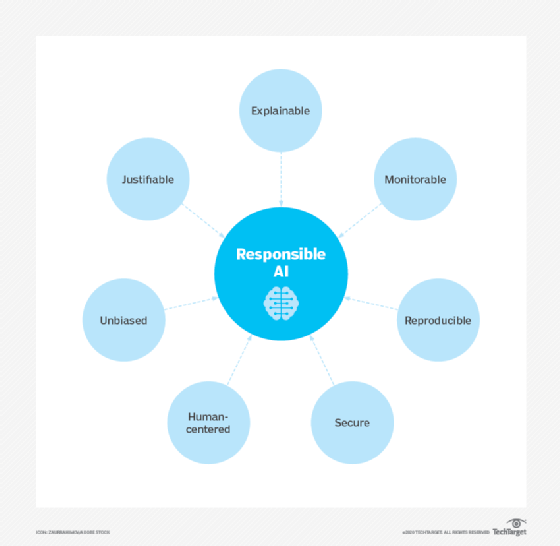
Responsible AI takes on greater importance in business as AI's offshoots develop greater cognition and independent thought.
So, when can we expect AGI?
It's impossible to predict when AGI will be commercially available due to several unpredictable variables, including the following:
The rush from AI to AGI resembles an industry "arms race" in which AI leaders are investing heavily and establishing aggressive AGI initiatives to be the first to market and set the standards.
AGI doesn't necessarily carry a single uniform definition. AI providers view AGI, its purpose and capabilities, in slightly different ways. Differing definitions will impact how much investment, work and infrastructure businesses will need to attain what each provider defines as AGI.
AGI still faces an array of technological, regulatory and societal hurdles from infrastructure availability and power to governance and social acceptance. Consequently, AGI is likely to arrive piecemeal in the form of more powerful and capable implementations over time.
Some of the more aggressive expectations suggest AGI will arrive sometime within the next year or two. More conservative estimates place its arrival around 2030, while other predictions peg meaningful and capable AGI between 2040 and 2060.
Beyond AGI: What of super intelligence?
The AI industry is currently pondering the eventual emergence of artificial superintelligence. While AGI is understood to be at "human-level" intelligence, ASI is considered "above human-level" intelligence. ASI is expected to outperform humans in every cognitive task -- decidedly faster, more strategic, more creative and far more knowledgeable than human intelligence.
Practically speaking, the move from AI to AGI to ASI is likely to progress seamlessly rather than as plateaus or eras, rendering any distinction between AGI and ASI almost meaningless. Regardless of the distinction, it's clear that ASI is still the stuff of science fiction.
We can only hope that advanced AI in whatever form it takes will sustain the better angels of human nature and not enable humanity's worst impulses.
Stephen J. Bigelow, senior technology editor at TechTarget, has more than 30 years of technical writing experience in the PC and technology industry.