Big data integration techniques and best practices to adopt
Data integration in big data systems is even more complex now because of AI. To succeed, it requires a strategy built on new approaches and strong data management.

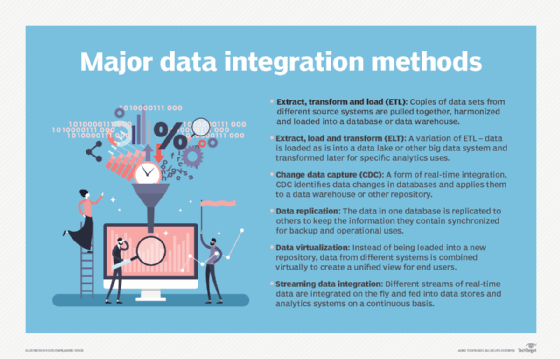
Effective data integration is essential for generating accurate analytics insights and AI outcomes in big data applications. But big data integration requires a shift away from traditional integration techniques to handle large volumes of diverse data often collected and processed at high velocity.
Big data environments provide new opportunities to derive insights from unstructured and semistructured data, such as website and application logs, emails, social media posts, images and IoT data streams. Conventional integration approaches fall short when teams need to work with this data, said Rosaria Silipo, a data scientist, author and co-host of the "My Data Guest" podcast.
Data integration is especially challenging when volume, variety and velocity -- the core 3 V's of big data -- are all factors in analytics and AI applications. Ad hoc integration for individual projects isn't viable in such scenarios, Silipo said. To avoid problems and maximize business value, data leaders must develop a comprehensive integration strategy that addresses big data's scale and complexity.
New challenges, new approaches
Current and complete data is critical to delivering trustworthy insights for business decision-making. But the extract, transform and load (ETL) integration approach used in traditional data warehouses is often a nonstarter in big data systems, said David Mariani, co-founder and CTO of semantic layer platform vendor AtScale.
Batch ETL processes struggle with large data volumes due to data transformation bottlenecks, making it difficult to keep pace with frequent data updates and dynamic analytics requirements. For example, an online retailer's overnight ETL jobs processing millions of daily transactions might exceed their processing windows, leaving business executives and analysts without up-to-date sales data the next morning. ETL is also poorly suited to unstructured or semistructured data because it requires data to be transformed into a predefined schema before loading.
The alternative ELT approach addresses these limitations by reversing the load and transform steps. Data is loaded into a data lake or lakehouse in its native format, then transformed and integrated as needed for specific big data use cases. ELT increases scalability, enabling data teams to process large volumes more efficiently and handle high-velocity updates. It also provides greater flexibility for supporting new applications and updating AI and analytics models as data changes.
Many organizations also deploy real-time data integration and processing technologies to deliver immediate insights in time-sensitive applications such as fraud detection, real-time personalization and operational or patient monitoring. Common real-time technologies include stream processing, event-driven architecture and change data capture. They enable teams to capture data as it's generated or updated and continuously load it into data platforms, often using an ELT approach to structure the data for different applications.
How AI agents complicate big data integration
The rise of agentic AI further complicates big data integration. Basic integration involves a one-directional pipeline: Data flows from source systems into a repository for analysis. More advanced applications support bidirectional data integration that directly feeds analytics insights back into operational systems. As organizations increasingly deploy AI agents, data teams might need to implement bidirectional integration at a much larger scale.
AI agents don't just access and analyze the data in a data lake or lakehouse, said David DuChene, senior manager of data and AI professional services at SHI International. They generate new outputs and surface latent relationships across data domains. Agents also autonomously push enriched insights back to the original source systems if configured to do so. That capability requires more extensive bidirectional integration capabilities, often operating continuously, DuChene said.
Data governance pressures also increase with agentic AI. Dan Federoff, vice president and head of data solutions at IT consultancy Bridgenext, said agents don't push back on bad data; they stealthily spread it across an organization. That makes effective data governance -- including strong data quality management and comprehensive data lineage documentation -- even more critical to successful big data integration in the AI era, Federoff said.
In addition, authorization and access control must become more dynamic, said Steve Touw, co-founder and CTO at data security platform vendor Immuta. AI agents operate at machine speed, often across systems and on behalf of multiple users with different permission levels. Touw recommended assigning identities to agents that dynamically assume the permissions of different users and configuring the integration layer to provision ephemeral, just-in-time roles. Doing so enables an agent to query data without holding permanent access privileges.
Best practices for big data integration
Adopt the following best practices to smooth out the big data integration process and ensure it meets business needs.
Create an all-encompassing data integration strategy
Rick Skriletz, founder and CEO of IT services provider InfoNovus Technologies, said successful integration efforts must work in harmony with several related data management functions:
- Data collection across multiple systems.
- Data processing, storage, security and preparation.
- Data backup for disaster recovery.
Without a cohesive integration strategy that clearly details how these functions all fit together, data management teams are likely to address each of them separately -- and less effectively, Skriletz said.
Treat data as a product
Data is often viewed as a byproduct of applications and systems. However, a cultural shift toward treating data as a product in its own right helps make the integration process more effective, said Jeffrey Pollock, vice president of data replication and streaming products at Oracle. That involves applying product management principles to data assets, with clear ownership, a defined purpose and a focus on data quality, usability and reliability.
Netflix has bought into the concept. Tomasz Magdanski, senior manager of data science and engineering at the streaming company, wrote in an October 2025 blog post that it's adopting a data-as-a-product framework "to ensure our data assets are managed with the same rigor and strategic focus as traditional products." The goal, he said, is to "elevate data to a first-class entity in our organization's thinking" and ensure that it's trustworthy and aligned with strategic business goals.
Capture critical metadata
Data integration depends on metadata that describes the data elements flowing into a data lake or lakehouse. It's commonly captured in two tools for different users:
- A logical data model documents business and technical metadata that data teams use to plan integration work and resolve common problems -- such as data with different structures, inconsistent naming conventions and varying quality levels.
- A data catalog creates an inventory of data assets with associated metadata, enabling data scientists and business users to find relevant data, understand its context and meaning, and identify datasets that need to be integrated for new use cases.
Incorporate integration into a data lifecycle management framework
Data lifecycle management (DLM) establishes policies and procedures for managing data from its creation through archiving and deletion. Data integration should be a core component of an organization's DLM framework. Incorporating it into a systematic framework -- with documented methodologies and governance structures -- is especially critical in big data environments, where volume and complexity make a less rigorous approach unsustainable.
Take an enterprise-wide approach
Maximizing the business value of big data initiatives requires an enterprise-wide approach to data integration rather than isolated implementations in individual departments or business units, according to Faisal Alam, technology consulting leader for the industrial and energy sectors at EY Americas. Siloed integration efforts limit the cross-functional data access and analytics insights needed for strategic decision-making across an organization.
Editor's note: This article was updated in June 2026 for timeliness and to add new information.
George Lawton is a journalist based in London. Over the last 30 years, he has written more than 3,000 stories about computers, communications, knowledge management, business, health and other areas that interest him.
Dig Deeper on Data integration
-
![]()
Hyland releases AI agent platform and vertical integrations
By: Don Fluckinger
-
![]()
WisdomAI Embedded Agentic Analytics puts colour into white-labelled AI
By: Adrian Bridgwater
-
![]()
Sagacious software: WisdomAI analytics agents act autonomously, with context
By: Adrian Bridgwater
-
![]()
Google unveils data cloud purpose built for agentic AI
By: Eric Avidon